My experiences teaching human anatomy and physiology

In this post I will focus on the concepts, principles and personal perspectives of using education technology in medical education, its purpose, impact, necessity and challenges. What it means to me and to my students. How they are learning in an authentic space, the process, advantages and challenges.

I teach applied human anatomy and physiology at graduate and post-graduate level at two different universities; the cohort of students age range from 18 to 67 years. I have one of the best jobs in the world because I work in an industry which is ever evolving, and I get to work with people who are creative, insightful and energetic. 27 years of basic human medical sciences teaching experience have taught me that two things are needed: evidence based smart education technologies and relationship with students in a student-centered classroom environment. We are in one of the great times of advancements and innovations and this is a great time to study technology in education, in the past decade technology in education was merely a word without actual digital or methodological input in teaching. We are in 21st century with smart and ultra-modern evidence-based education technologies and methodologies which are helping both the students as well as the facilitators (Office of Education Technology, 2017). I will discuss in detail how education technology is used in basic medical sciences, how it resonates with me, how I use it, what are the challenges.

My experiences teaching human anatomy and physiology without technology.

Human anatomy and physiology are foundation subjects in medical education, and to succeed in this basic medical sciences subject, students are subjected to various methodologies, pedagogies, and terminologies (Charkhat Gorgich E A, 2017). This subject in the initial days of the exposure to students, either makes them or breaks them, because of the overwhelming terminologies, complex concepts and practical dissections on a human cadaver. The terminologies and the associated language of human anatomy and physiology are totally alien for the fresh students, at this time, I have seen subsequent dropout of the students from the college. In addition to this overwhelming experience, when the students are exposed to the dissection of human cadaver, majority of them show the signs of grief, sorrow and emotional disturbances. The walk itself in the anatomy dissection lab for some students is really challenging because of the smell of strong chemical preservatives and the smell from cadaver.

The above-mentioned student experiences and the physical learning space are not supportive and conducive to the learning environment. As human anatomy and physiology is the fundamental language of medicine, the students need to know the terminologies and language associated with it. The teaching process requires the usage of approximately 9,000 medical terminologies and various sessions of practical dissections on human cadaver throughout the duration of course, students learning processes are slow and challenging in the earlier days (Dissabandara, 2015). I will now explain what I teach and how I use technology in my teaching practice.

My experiences teaching human anatomy and physiology with technology.

I love my job and I have a passion to educate and learn, I love technology in education, and I am very fond of corroborating 4c’s concept while implementing technology in my teaching: collaboration, communication, critical thinking and creativity. Collaboration helps me achieve a common goal by working together as a team with the students. Effective communication helps me convey my ideas to the students and students in turn have an open platform to convey their ideas. As a team critical thinking is all about providing solutions to the problems and it helps me to be closer to my students and lastly creativity with the help of technology helps me and my students think outside the box (Applied Education Systems, 2019). I am proactive in taking part in continuous education development workshops, conferences and seminars to keep abreast with the advancement in both methodologies and latest technologies in education.

I am focused on using latest technologies in my teaching practice, as it helps me deliver the complex human anatomical and physiological concepts in detail with ease and positive outcome. The usage of variety of resources and creative technologies in my teaching practice have reduced the overwhelming and emotional response of my students. We no longer go to the anatomy dissection lab regularly, instead we use creative pedagogical methods along with the traditional didactic method of teaching and then apply the principles of learning using latest technology, instead of performing a traditional cadaver dissection, I use innovative digital materials like stereoscopic images, 3d computer-based models, virtual dissecting table, immersive simulation visualizations, virtual reality, augmented reality and holograms (Petersson, 2009).

What it means to me and to my students.

The usage of above-mentioned pedagogies and latest technologies have increased student interactivity, the level of creative thinking increased. The exercises became very easy for me to facilitate and for the students, they could easily assimilate and synthesize the anatomical facts that they have just heard in the lecture and seen in the cadaver on the virtual dissecting table. When the concepts were explained to the students, they were not just receiving knowledge or being lectured, they started to understand the concept on a completely different level, which was deeper and more ingrained than it’s not just something that they see and forget. The most important outcome is every student is engaged and is a part of the team. I feel like I am in real terms of student-centered atmosphere by cooperating at the students’ level, by getting involved in the problem solving and allowing the students to learn with different styles using the powerful tools of technologies in understanding and learning. The human anatomy and physiology have both the components of critical thinking and project-based learning, the usage of technology has helped me, and my students achieve the learning outcomes of the micro and the macro concepts of the course (The University of Adelaide, 2019).

Learning space

The traditional learning space is replaced by authentic and more interactive learning space. In comparison with traditional learning space, which required physical presence in an anatomical dissection lab, the students are more relaxed, focused, engaged and creative (Sawers, 2016). The usage of authentic learning space in the form of virtual dissection table allows us to reconstruct the section of two-dimensional images into three-dimensional images with the help of software. I as a lecturer and facilitator can demonstrate and dissect through the body in layers or select human body structure sections to display on big screen projector in real time, and establish a rock-solid visual understanding of anatomical relationship of various body organs and organ systems, this is something that I can’t do on a cadaver in physical traditional space (Hoyek, 2014).

The impact on learning in an authentic space and its advantages

The use of technology and adaptation of new methods in teaching enhanced the ability of my students to understand and demonstrate the fundamental concepts, terminologies and the application of language of anatomy. They were able to do more in the class sessions, solve problems, remember and retain the gained knowledge. The advantages of authentic space: Authentic space classroom atmosphere helped me and my students in achieving real-world learning tasks with a flexible and evolved learning space, because we were using the virtual dissection table, student were free to move around the projected holographic cadaver image,     students were free to choose and select most of the relevant content for their learning, students demonstrated different approaches of problem solving for the given topic, real time regular and frequent feedback was delivered with informed instructions, peer respect and knowledge is shared, demonstration of understanding increased by the free choice, creativity increased and lastly assessments were based on understanding and the knowledge gained (Stanford University, 2019). The major outcome is that students have 24/7 access to the technology, they can use it anywhere and at any time, this helps them to learn, build up knowledge and reconsolidate their concepts about the human anatomy and physiology. It is quite evident the students are totally involved in learning by solving the real problems in real time. The authentic learning space have provided them the student-centered atmosphere, they were able to take ownership, solve the project-based learning activities and were clearly demonstrating applied understanding (Peter Goss, 2017).

The advantages I have successfully accomplished

The usage of stereoscopic images, 3d computer-based models, virtual dissecting table, immersive simulation visualizations, virtual reality, augmented reality, holograms along with 4C’s corroboration has helped me achieve the following:

Enhanced and close contact between students and myself.

Cooperation and reciprocation are increased.

Creation of active and integrated learning atmosphere.

Real time and prompt feedback are made possible.

Strong emphasis on completion of task on time.

Accommodation of diverse talents and different ways of learning (Oblinger, 2019)

Challenges using technology in medical education

There are too many teachers assume that they are competent and assume that students are learning and there are too many students who assume that they know how to use technology for learning, but in fact they are doing it totally wrong. Competency, effective and ethical use of technology by the facilitators is an overall issue and a standing challenge (Latham, 2019). Improper setup by the service providers can be a hindrance to learning. The assumptions and prejudices from students are ever growing, they assume that after finishing the course on augmented reality based virtual dissection table, they think that they will be able to perform autopsies and can perform real time dissections on human cadaver. The other challenges what I face on regular basis are:

Distractions in class, because of the usage of hologram projections and other virtual reality-based technologies (Digital distraction and dependency).

Shorter attention periods, some of the students have very short attention spans.

                  Playing with the digital equipment rather than learning  (Rodríguez-González, 2019).

As an educator I find it difficult sometimes to bring to attention of the students some fundamental concepts as they get carried away very easily, especially when they are using immersive technologies.

Outsourcing help for assignments. This is my major concern and a great challenge for me, academic integrity is at risk in certain areas when we are using technology in education (Mellar, 2018).

Ease of accessibility may create unethical use of technology.

Security and privacy, the risk factors are more prevalent when the students are in online classrooms (Study.com, 2019).

Conclusion

In conclusion I am blessed to have the required competencies in my field of teaching and usage of technology. However, majority of the medical and health universities in the developing countries as well as some developed countries still lack the basic framework of latest technology in medical education. The main issue I would like to highlight here is that technologies like stereoscopic images, 3d computer-based models, virtual dissecting table, immersive simulation visualizations, virtual reality, augmented reality and holograms are not easily available to the lecturers and students in many countries. This might be a hindrance in getting the students creative, collaborative and interactive. The teachers will not be able to engage and facilitate student and may not be able to give real time feedback (Codd, 2011). Continuous learning, critical thinking, problem solving, creativity, interactivity, communication and collaboration are the key aspects of the teaching and learning (Anna Rosefsky Saavedra, 2012). Furthermore, I would like to discuss here in addition to the usage of latest digital technology in providing human anatomy and physiology education, the importance and incorporation of various education technology models like Punya Mishra and Matthew J. Koehler’s 2006 TPACK framework (Matthew J. Koehler, 2019), SAMR Model developed by Dr. Ruben Puentedura (Puentedura, 2019) and artificial intelligence has helped me in many ways, I have a full attendance of students and they are always looking forward for lectures and sessions conducted using the amalgamation of digital technology and mentioned education models.

References

Anna Rosefsky Saavedra, V. D. (2012). Teaching and Learning 21st century Skills: Lessons from the Learning Sciences. Sydney: Rand Corporation.

Applied Education Systems. (2019, November 27). What Are the 4 C’s of 21st Century Skills? Retrieved from Applied Education Systems: https://www.aeseducation.com/career-readiness/what-are-the-4-cs-of-21st-century-skills

Charkhat Gorgich E A, S. M. (2017). Medical Students Knowledge About Clinical Importance and Effective Teaching Methods of Anatomy. Shiraz E-Med Journal, 18(12):e14316. doi:doi: 10.5812/semj.14316.

Codd, A. &. (2011). Virtual Reality Anatomy: Is it Comparable with Traditional Methods in the Teaching of Human Forearm Musculoskeletal Anatomy? Anatomical sciences education, 4. 119-25. doi:10.1002/ase.214

Dissabandara, L. O. (2015). Role of cadaveric dissections in modern medical curricula: a study on student perceptions. Anatomy & cell biology, 48(3), 205–212. doi:doi:10.5115/acb.2015.48.3.205

Hoyek, N. &. (2014). Effectiveness of Three-Dimensional Digital Animation in Teaching Human Anatomy in an Authentic Classroom Context. Anatomical sciences education, 7-10.

Latham, G. (2019, December 7). What are the qualities required of teachers to teach 21st century learners? Retrieved from Researchgate: https://www.researchgate.net/post/What_are_the_qualities_required_of_teachers_to_teach_21st_century_learners

Matthew J. Koehler, P. M. (2019, December 7). The Technological Pedagogical Content Knowledge Framework . Retrieved from punyamishra: https://www.punyamishra.com/wp-content/uploads/2013/08/TPACK-handbookchapter-2013.pdf

Mellar, H. P.-F. (2018). Addressing cheating in e-assessment using student authentication and authorship checking systems: teachers’ perspectives. International Journal for Educational Integrity, 14, 2 . doi: doi:10.1007/s40979-018-0025-x

Oblinger, D. G. (2019, December 7). Learning Spaces. Retrieved from EDUCAUSE: https://www.educause.edu/ir/library/pdf/pub7102.Pdf

Office of Education Technology. (2017). Reimagining the Role of Technology in Education. Brooklyn: U.S. Department of Education. Retrieved from https://tech.ed.gov/files/2017/01/NETP17.pdf

Peter Goss, J. S. (2017). Grattan Institute Report. Brisbane: Grattan Institute .

Petersson, H. &. (2009). Web-Based Interactive 3D Visualization as a Tool for Improved Anatomy Learning. Anatomical sciences education, 2. 61-8. doi:10.1002/ase.76.

Puentedura, R. R. (2019, December 7). SAMR: A Brief Introduction. Retrieved from Ruben R. Puentedura’s Blog: http://hippasus.com/blog/archives/227

Rodríguez-González, L. U. (2019). Learning Technology for Education Challenges. Switzerland: Springer Nature . Retrieved from https://link.springer.com/book/10.1007%2F978-3-030-20798-4

Sawers, K. M. ( 2016). What Drives Student Engagement: Is it Learning Space, Instructor Behavior or Teaching Philosophy? Journal of Learning Spaces, 2-5. Retrieved from http://libjournal.uncg.edu/jls/article/vi

Stanford University. (2019, December 5). Body image: Computerized table lets students do virtual dissection. Retrieved from Stanford University: https://med.stanford.edu/news/all-news/2011/05/body-image-computerized-table-lets-students-do-virtual-dissection.html

Study.com. (2019, December 7). Ethical Issues with Using Technology in the Classroom. Retrieved from Study.com: https://study.com/blog/ethical-issues-with-using-technology-in-the-classroom.html

The University of Adelaide. (2019, December 3). Collaborative learning — annotated bibliography. Retrieved from The University of Adelaide: https://myuni.adelaide.edu.au/courses/24276/pages/collaborative-learning-annotated-bibliography?module_item_id=1036925
Nurturing The Passion to Care Through Education

Use of technology in education, my learning experiences, exposures and its application in teaching practice. Post 2

Education Technology for hyper-connected students.

We are almost two decades in 21st century, we are living through a massive educational technology revolution. The impact is felt by billions of people around the world, the pace of change is amazing. The typical students average nearly 1,000 Facebook friends, they consume, produce and communicate information with the use of technology in previously unimaginable ways (Sonia Livingstone, 2016). These students are very active on social media, which enables them to be effectively networked, connected and have access to open learning beyond the closed boundaries of classroom. The education industry is forced to make big changes to these hyper connected students and teachers, building 21st century skills, using enabling education technologies, which are subjective and personalized to engage students in diverse and creative ways (Mitchell, 2014).

In my 26 years of teaching experience as a lecturer I have seen both the technology and teaching methods evolved exponentially from traditional to the latest contemporary modern trends. The black boards evolved to whiteboards to static slides to digital projectors to interactive white boards to smart touch screens to modern smart digital boards. The teaching methods using education technology also had a greater impact in facilitating effective learning environment by using flipped classroom blended learning model with redefined learning spaces providing students a comfortable sitting ambiance (Victoria University, 2019). The problem Based Learning shifted to Project Based Learning by incorporating STEM method (Robert M. Capraro, 2013). 

I will outline how the latest advancements in education technology which have impacted me and the education industry, and changed the approach of teaching, delivering, communicating, and facilitating student learning. The concepts, processes and models of education technology are better understood by the following:

  • The role of technology in education
  • Technological applications
  • Models to support teaching and learning

The role of technology in education

I have been using technology as a part of teaching and learning environment in one form or the other, it helps me engage and facilitate student learning. Technology in education has become an integral part of education industry in Australia and worldwide, as it has become an essential component for both educators and students in creating, sharing, and developing new resources to produce high quality well informed skilled graduates (Tyler, 2007).

Technological applications

It is important to use technology appropriately as per its application rather than its availability. As an educator, I have many considerations in using and applying technology. In my experience technology in education should influence learning outcomes, innovating curriculum, pedagogy, effective assessments, increased professional development. Application of education technology from perspective of a teacher provides new ideas, concepts and saves time and from student’s perspective it provides easy accessibility to study material at any given time as per their convenience, thereby helping them achieve maximum understanding and success in their exams (Oblinger, 2005).

Models to support teaching and learning

Continuous learning, critical thinking, problem solving, creativity, interactivity, communication and collaboration are the key aspects of the teaching and learning (Anna Rosefsky Saavedra, 2012). Teachers and students are a team in the world of education. Various models are designed to support and enhance the teamwork among students and teachers.

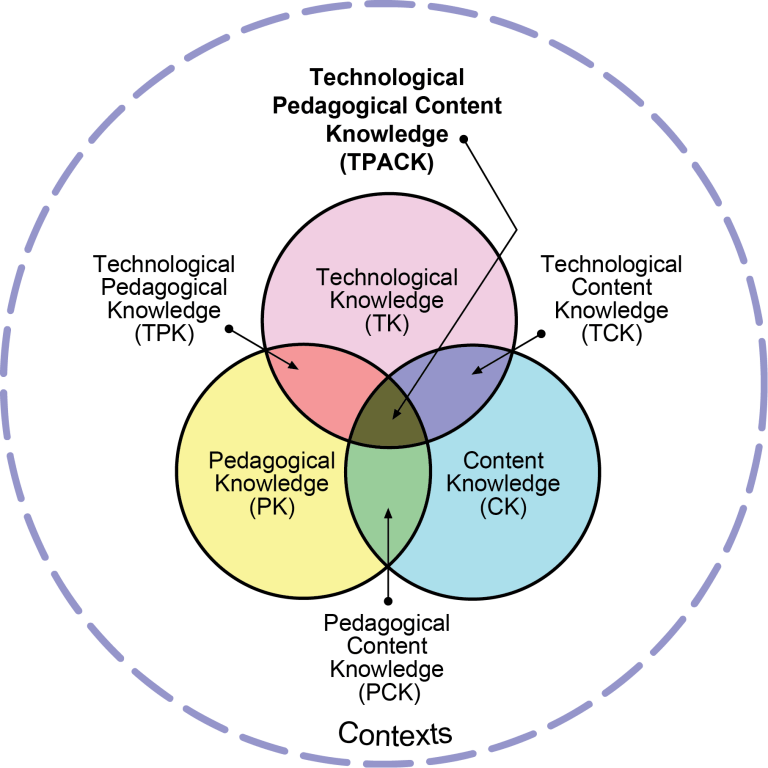
Punya Mishra and Matthew J. Koehler’s 2006 TPACK framework, which focuses on technological knowledge (TK), pedagogical knowledge (PK), and content knowledge (CK), equips educators to effectively implement education technology in their classes. In this framework the educators follow the specific order of when and what content is being taught, how the content is delivered to the students (pedagogy). This enables the education technology to be implemented, communicated, explained in order to enhance student’s learning experiences. In my teaching practice I use digital literacy along with hardware, software, applications and associated information, this helps me guide and instruct students to attain complete understanding of the subject concepts thereby meeting the learning outcomes (Mishra, 2019).

TPACK model diagram

Figure 1 – The TPACK model retrieved from: (https://www.punyamishra.com/research/tpack, 2019)

SAMR Model

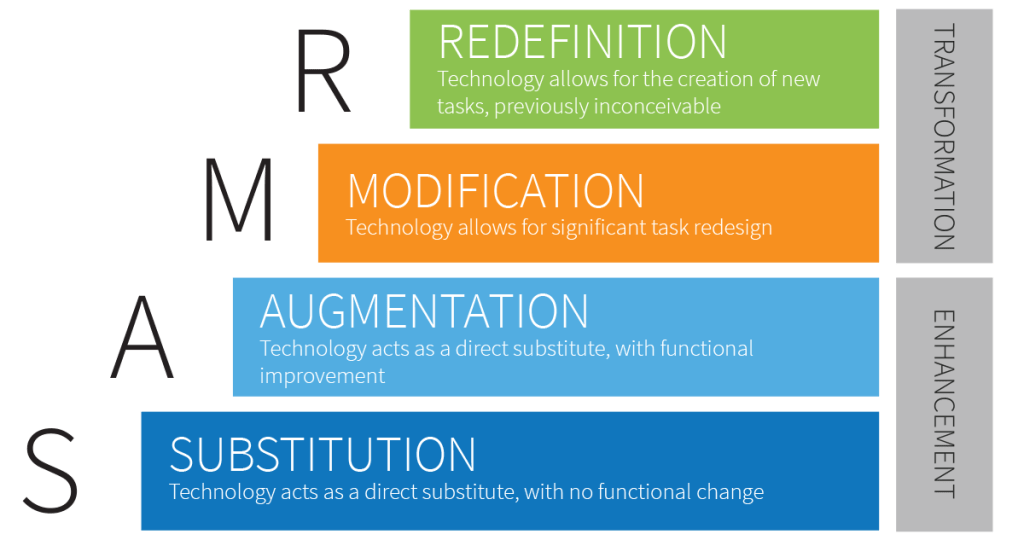
This unique model was developed by Dr. Ruben Puentedura. SAMR model has been developed to create an understanding how technology is being integrated in education. It begins with the most simplistic use of technology and gradually becomes more complex thereby facilitating deep learning skills. SAMR stands for substitution augmentation modification redefinition. This model is designed to help educators integrate technology into teaching and learning and it aims to enable teachers to design, develop and integrate digital learning experiences that lead to high levels of achievement for students. It is a model used to select, use and evaluate technology to implement in day to day teaching activities in a typical classroom (Schoology Exchange, 2019). This unique model has helped me tremendously in injecting new interactive human anatomy and physiology applications and software’s in my teaching practice, my students are very well versed specially in augmentation and redefining parts of this model.

A screenshot of a cell phone

Description automatically generated

Figure 2 – The SAMR model retrieved from: (https://www.schoology.com/blog/samr-model-practical-guide-edtech-integration, 2019)

STEM

STEM stands for Science Technology Engineering and Mathematics. It represents a unique approach to teaching and learning, which centers around individual students learning styles and interests. STEM education has something to offer every student unlike traditional education experiences in which subject areas are concentrated on separately. STEM education emphasizes technology and integrate subjects in ways that connect disciplines and relate them to each other, as it moves beyond traditional tests and quizzes, it focuses on developing higher-level thinking skills by connecting classroom learning to the real world. STEM emphasizes collaboration, communication, research, problem solving, critical thinking, and creativity skills that students need to be successful in today’s world regardless of specific interests or career goals (Thomas Roberts, 2018). As per the National STEM school education strategy 2016 – 2026, STEM is a direct response to the realization that our future will be built on our capacity for innovation invention and creative problem-solving. The National STEM school education strategy concludes that STEM education plays a vital part in the future of the Australian education system and our ability to effectively train future students who can be global innovators and world leaders (Education council, 2015).

Flexible Classrooms: Making Space for Personalized Learning

The concept of providing flexible space gives students the opportunity to learn in different ways, and it gives teacher the opportunity to coach them properly in a personalized manner to reach their learning goals. It is flexible not only in terms of the physical space, but also flexible in in terms of the different choices that students have (University of Melbourne, 2011). As I am enjoying Flipped classroom teaching method graciously incorporated by Laureate International University Australia and New Zealand (Torrens University, 2019). The seating arrangement is unique, it is like a café style relaxed sitting arrangement, where students have their own choice to sit in groups or individually. The students who are seated individually are working independently and those who are seated in groups are working collaboratively. This flexible seating arrangement gives the students freedom and choice for their different styles of learning (Delzer, 2019).

In conclusion, the TPACK framework is useful for organization of types of knowledge and technology integration in a typical teaching environment. Both students and teachers get benefit of this content-driven, pedagogically-sound, and technologically forward knowledge (McGraw-Hill, 2019). SAMR Model helps in understanding how technology in education is integrated and how this model facilitates deep learning skills (Robert M. Capraro, 2013). STEM education helps in integrating technology and subjects, thereby connecting various disciplines and relating them to each other (Robert M. Capraro, 2013). Flexible learning spaces increases student’s participation and engagement, providing them the best aspects of understanding using their own choices to achieve maximum learning (Peter Barrett, 2013).

References

Anna Rosefsky Saavedra, V. D. (2012). Teaching and Learning 21st century Skills: Lessons from the Learning Sciences. Sydney: Rand Corporation. Retrieved from https://www.aare.edu.au/data/publications/2012/Saavedra12.pdf

Delzer, K. (2019, November 5). Flexible Seating and Student-Centered Classroom Redesign. Retrieved from Edutopia: https://www.edutopia.org/blog/flexible-seating-student-centered-classroom-kayla-delzer

Education council. (2015). National STEM school education strategy 2016 – 2026. Carlton South Vic: Education council. Retrieved from http://www.educationcouncil.edu.au/site/DefaultSite/filesystem/documents/National%20STEM%20School%20Education%20Strategy.pdf

McGraw-Hill. (2019, November 5). What is the TPACK theory and how can it be used in classroom? Retrieved from McGraw-Hill Higher Education: https://www.mheducation.ca/blog/what-is-tpack-theory-and-how-can-it-be-used-in-the-classroom/

Mishra, P. (2019, October 31). Living at the junction of education, creativity, technology & design. Retrieved from Puny Mishra’s Web: https://www.punyamishra.com/research/tpack/

Mitchell, D. (2014). Education that Fits. ChristChurch: College of Education. Caterbury University. Retrieved from https://www.education.vic.gov.au › Documents › about › psdlitreview

Oblinger, D. G. (2005). Educating the Net Generation. Washington: EDUCAUSE. Retrieved from https://www.educause.edu/ir/library/PDF/pub7101.PDF

Peter Barrett, Y. Z. (2013). A holistic, multi-level analysis identifying the impact of classroom design on. Building and Environment, 678-689. doi:https://doi.org/10.1016/j.buildenv.2012.09.016

Robert M. Capraro, M. M. (2013). STEM Project-Based Learning. Rotterdam: Sense Publishers. Retrieved from https://www.sensepublishers.com/media/1522-stem-project-based-learning.pdf

Schoology Exchange. (2019, November 2). SAMR Model: A Practical Guide for EdTech Integration. Retrieved from Schoology Exchange: https://www.schoology.com/blog/samr-model-practical-guide-edtech-integration

Sonia Livingstone, J. S.-G. (2016). The Class: Living and Learning in the Digital Age. New York: New York University press. Retrieved from https://books.google.com.au/books?id=HgHMCgAAQBAJ&pg=PA89&lpg=PA89&dq

Thomas Roberts, C. J.-S. (2018). Students’ perceptions of STEM learning after participating in a summer informal learning experience. International Journal of Stem Education, 5(1): 35. doi:10.1186/s40594-018-0133-4

Torrens University. (2019, November 3). Diploma of Health Science Information Set. Retrieved from Torrens University: https://www.torrens.edu.au/course/diploma-of-health-science-information-set

Tyler, R. (2007). Re-imagining Science Education: Engaging students in science for Australia’s future. Camberwell: Australian Council for Educational Research. Retrieved from https://research.acer.edu.au/cgi/viewcontent.cgi?article=1002&context=aer

University of Melbourne. (2011). Does the space make a difference? Brisbane: Churchie. Retrieved from https://www.churchie.com.au/churchie/media/Documents/Churchie-s-New-Generation-Learning-Spaces-Booklet.pdf

Victoria University. (2019, October 27). Blended learning & flipped classrooms. Retrieved from Victoria University: https://www.vu.edu.au/learning-teaching/learning-teaching-development/learning-teaching-approaches/blended-learning-flipped-classrooms

The Use of Technology in Education

The Use of Technology in Education

Use of technology in education, my learning experiences, exposures and its application in teaching practice. Post 1

In this post, I will focus on the importance of ever evolving/innovating technology in education, its purpose, impact and necessity. Technology as it has many definitions, it can be well described in the paradigm of medical education “the application of body of knowledge for practical purposes in teaching and learning”. (Hansen, 1994). It is a reality and a fact that as the world outside the boundaries of educational institutions is changing faster and faster, most of the teachers and students are not being well equipped to succeed in the future that’s competitive and challenging. We’re embracing a unique era where there’s a lot of value to evolve, innovate and formulate new trends in every field not just in education. (McLaughlin, 2019) As an academic in medical education, these innovative technologies in education played a very important role and had a great impact on my domain of medical education. In this post I will focus on the importance of ever evolving/innovating technology in education, its purpose, impact and necessity. Technology as it has many definitions, it can be well described in the paradigm of medical education “the application of body of knowledge for practical purposes in teaching and learning” (Hansen, 1994). It is a reality and a fact that as the world outside the boundaries of educational institutions is changing faster and faster, most of the teachers and students are not being well equipped to succeed in the future that’s competitive and challenging. We’re embracing a unique era where there’s a lot of value to evolve, innovate and formulate new trends in every field not just in education (McLaughlin, 2019). As an academic in medical education, these innovative technologies in education played a very important role and had a great impact on my domain of medical education. In this post, I will focus on the importance of ever evolving/innovating technology in education, its purpose, impact and necessity. Technology as it has many definitions, it can be well described in the paradigm of medical education “the application of body of knowledge for practical purposes in teaching and learning”. (Hansen, 1994). It is a reality and a fact that as the world outside the boundaries of educational institutions is changing faster and faster, most of the teachers and students are not being well equipped to succeed in the future that’s competitive and challenging. We’re embracing a unique era where there’s a lot of value to evolve, innovate and formulate new trends in every field not just in education. (McLaughlin, 2019) As an academic in medical education, these innovative technologies in education played a very important role and had a great impact on my domain of medical education.

As a passionate teacher/trainer I always had a desire to innovate and wanted to create new model of concepts for teaching, so that the students are well engaged, as I have seen in beginning of my teaching career, the model of education in a typical medical college set up was a mass production factory model, as it did not provide an individualized experience to the students (Shaw, 2019). Since 1989 I have seen variety of developments, which were monumental, as they changed from teacher centered facilitation to student centered pedagogies/learning and design changes in learning spaces with open classroom plans, this was just because of the inculcation of the latest innovative methods and technologies in education. (Byers, 2019). I have embraced these changes graciously with all positivity and open-ness, which made me an effective learner and a practical passionate teacher.

The changes I have experienced as a lecturer within the course curricula and in class teachings were rapid, and these were influenced by the following factors:

  • Redesigning of learning spaces and classrooms (Byers, 2019)
  • Changes in sitting arrangements (Barrett P. S., 2013)
  • Diversity of pedagogical techniques (Amer F. Ahmed, 2018)
  • Latest advanced educational tools using digital technology
  • Incorporation of Social media and online networking (Whyte W, 2017)

Purpose: The purpose of using advanced technology in medical education fulfilled the following:

  • Acquisition of fundamental knowledge
  • Decision making
  • Skill coordination
  • Psycho motor skill improvement
  • Team based learning
  • Practice on virtual Human body
  • 3D visualization of dissection of human body (Guze P. A, 2015)

The Impact: These advancements in medical education technology has a greater impact on my learning and teaching methods and made me understand very well the importance and need of technology, pedagogy and content, the fundamentals of TPACK (Mishra, 2006). The inclusion of virtual reality, interactive human physiology and anatomy technologies were a great boost to my teaching techniques, even though these required training and time. I adopted and incorporated this unique virtual reality-based software and interactive technology very effectively in my teaching practice by providing enhanced content. Application and usage of these technologies made me an effective facilitator and my classes have an interactive, exciting, engaging and team-based learning atmosphere. The students are now able to get individualized and subjective attention and personalized experience, this has changed the mass production factory model of producing health care professionals to well informed, passionate and caring healthcare professionals.

Necessity: Interactive digital human physiology/anatomy and virtual reality technologies can help basic medical sciences academics to integrate latest creative ideas in their learning outcomes by compiling audio visual effects, 3D animations, videos, worksheets and concept questions with ease (Amy Heather, 2019). The use of these technologies can help increase student attendance, interaction and engagement. The students can demonstrate an effective understanding by self-manipulation of the interactive technology, linking their earlier and current learning experiences both inside and outside the classroom. The use of this unique pedagogical technology-based concept can make students to be highly creative, interactive, motivated, engaged, well informed, and technology literate. (Workman, 2019)

In conclusion, the inclusion of educational technology innovations and social media increased peer connectivity, students became more collaborative as they were able to express their individual ideas clearly and concisely. Understanding of subject, engagement and collaboration increased, the classrooms became more positive, energetic and facilitation of teaching and training concepts are made easy. Because of the social media connectivity and various online platforms, the student queries were answered in real time, the feedback to their assessments were given on time with utmost subjectivity and confidentiality. To my colleagues in healthcare education I would like to advise them to use online platforms like TED-Ed, Participate, Edu-Clipper, Kahoot and Thing Link. (Chauhan, 2019)

References

Amer F. Ahmed, E. &.-E. (2018, February 21). Classroom Diversity and Inclusive Pedagogy. Retrieved from Association of College and University Educators ACUE: https://community.acue.org/blog/classroom-diversity-inclusive-pedagogy/

Amy Heather, T. C. (2019). Educational Strategies, Teaching and Learning, Technology, Basic and Foundation Sciences, Simulation and Virtual Reality. MedEdPublish , 1-18. doi: https://doi.org/10.15694/mep.2019.000077.1

Barrett P. S., Z. Y. (2013). A holistic, multi-level analysis identifying the impact of classroom design on pupils’ learning. Building and Environment, 678-689. doi:doi:10.1016/j.buildenv.2012.09.016

Byers, T. &. (2019, October 31). Does the space make a difference? The Churchie Experience. Retrieved from Churchie.com.au: https://www.churchie.com.au/churchie/media/Documents/Churchie-s-New-Generation-Learning-Spaces-Booklet.pdf

Chauhan, A. (2019, October 31). Digital Education Tools For Teachers And Students. Retrieved from eLearning Industry: https://elearningindustry.com/digital-education-tools-teachers-students

Guze P. A. (2015). Using Technology to Meet the Challenges of Medical Education. Transactions of the American Clinical and Climatological Association, 126, 260–270. Retrieved from https://www.ncbi.nlm.nih.gov/pmc/articles/PMC4530721/

Hansen, R. &. (1994). Defining technology and technological education: A crisis, or cause for celebration? International Journal of Technology and Design Education, 4: 179. doi:https://doi.org/10.1007/BF01204546

McLaughlin, P. T. (2019, November 8). The future of learning and teaching: Big changes ahead. Retrieved from RMIT School of Education : https://www.rmit.edu.au/study-with-us/education/discover-education/the-future-of-learning-and-teaching-big-changes-ahead-for-education

Mishra, P. &. (2006). Technological pedagogical content knowledge. A framework for teacher knowledge . Teachers College Record, 1017-1054. doi:https://doi.org/10.1111/j.1467-9620.2006.00684.x

Shaw, A. (2019, November 2). Factory Model vs 21st Century Model of Education. Retrieved from Linkedin: https://www.linkedin.com/pulse/factory-model-vs-21st-century-education-anne-shaw/

Whyte W, H. C. (2017). Social Media use within medical education: A systematic review to develop a pilot questionnaire on how social media can be best used at BSMS. MedEdPublish , 6, [2], 21. doi:https://doi.org/10.15694/mep.2017.000083

Design a site like this with WordPress.com
Get started